FROM DARKNESS TO LIGHT: THE SPIRITUAL JOURNEY OF MILAREPA
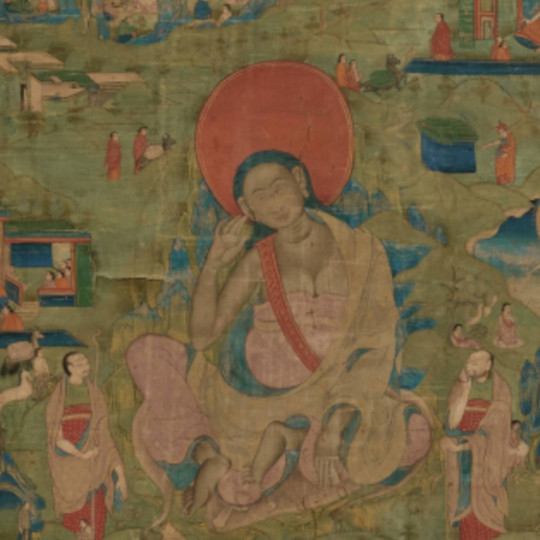
The story of Milarepa is one of the most captivating in Tibetan Buddhism: a young man consumed by vengeance who, through harsh trials and a profound inner journey, manages to completely transform his life. The thangka that portrays him, featured in the upcoming Oriental Art auction by Aste Bolaffi, offers an opportunity to rediscover this figure through one of his most iconic and meaningful representations.
Vengeance and Enlightenment of Milarepa
Milarepa, born Mila Thö-pa-ga in a village in western Tibet, endured a childhood marked by tragedy. When he was still a boy, the death of his father and the greed of his uncles plunged his family into misery.
Driven by a desire for revenge, he learned black magic and, according to legend, summoned dark forces that caused death and destruction. Yet Milarepa refused to remain a prisoner of his own actions. Overwhelmed by remorse and horrified by what he had done, he sensed the depth of his wrongdoing and felt within himself a growing urge for change.
His turning point came with the encounter with Master Marpa, who subjected him to a grueling path marked by silence, rejection, and extreme physical effort. Marpa ordered him to build large stone towers entirely on his own and, once completed, to tear them down and return each stone to its original place. Then he demanded that Milarepa rebuild them elsewhere, only to destroy them again. This exhausting cycle was meant to break his pride and purify a karma weighed down by years of black magic and vengeance.
Alongside these tasks, Milarepa was publicly humiliated, repeatedly dismissed by the master, and sent to perform harsh labor under the sun, among stones, boulders, and barren fields. It was a brutal training that pushed him repeatedly to the brink of exhaustion and despair.
But it was precisely when the disciple had nothing left that Marpa revealed the hidden meaning of those trials. Every stone lifted, every humiliation endured had cleansed his past, making him finally worthy of receiving the deepest tantric teachings. From that moment on, Milarepa could begin the true spiritual journey that would transform him into one of the most revered yogis in Tibetan Buddhism.
In the Tibetan tradition, Milarepa stands as a symbol of hope. He embodies the idea that redemption is not granted only to the pure, but also to those who, emerging from the darkest mistakes, find their way back to the light.
The painting depicting Milarepa is on auction
This story, so rich in symbolism and transformation, lives on today in a refined thangka portraying Milarepa in his most iconic posture. Thangkas served as visual tools for meditation, teaching aids in monasteries, and supports for depicting buddhas, masters, mandalas, and sacred scenes.
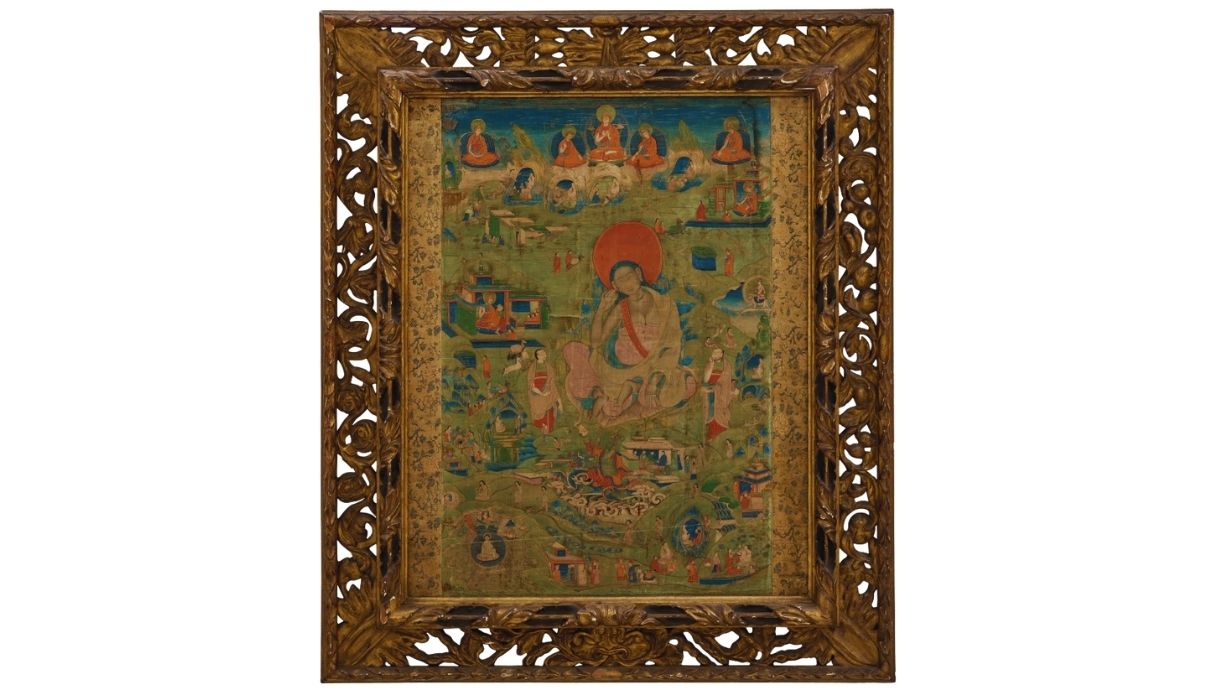
At the center of this composition, Milarepa is shown in the relaxed pose of a meditating yogi, wrapped in a simple white cotton mantle—a symbol of his ascetic life and renunciation of material possessions. His head is slightly tilted, with his gaze turned inward, an expression that conveys the essence of the enlightenment he attained in solitude in the Himalayan caves.
His right hand, raised elegantly to his ear, recalls the tradition that describes him as “the saint who listens to the songs of the Dharma.” Milarepa was indeed renowned for composing and chanting poetic verses—true spiritual teachings expressed through song.
Surrounding the central figure is the rich ornamentation typical of thangkas: a vibrant background often punctuated by natural elements, stylized clouds, floral motifs, or rays of light symbolizing the purity of an awakened mind.
This painting will be offered in the upcoming Oriental Art auction organized by Aste Bolaffi, to be held in Turin on December 15, with online participation available. A journey through 563 lots spanning the culture and art of Japan, China, and Tibet, alongside pieces from Southeast Asia, the Middle East, and Pre-Columbian America.
Browse the catalogue